
Ytidica
Pantoprazole Sodium IP eq. to Pantoprazole 40 mg gastro-resistant tablets
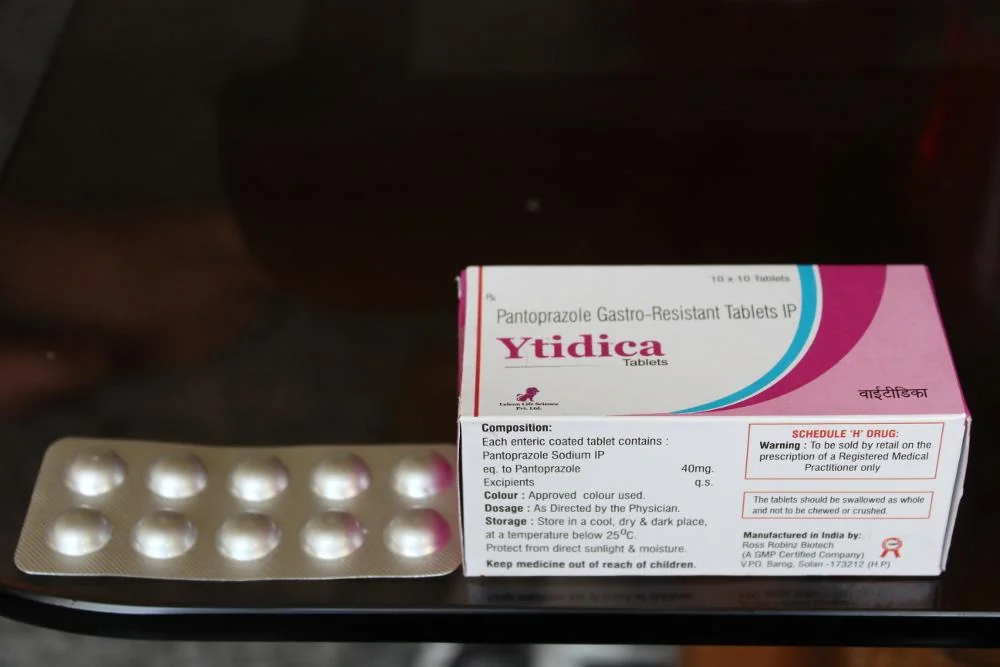
Kindly consult your Doctor before taking medication.
Keep out of reach of children.
Product facts
| Brand | Ytidica |
|---|---|
| Composition | Pantoprazole Sodium IP eq. to Pantoprazole 40 mg gastro-resistant tablets |
| Dosage form | Enteric-coated tablet |
| Class | Proton-pump inhibitor |
| Category | Schedule H |
| Pack | 10 x 10 tablets |
| Storage | Store in a cool and dry place below 25 °C. |
| Safety | Keep medicine out of reach of children. |
| Therapy area | Gastroenterology |
| Marketed by | Leleon Life Science Pvt. Ltd., Mumbai |
A proton-pump inhibitor. Prescription product for use under the supervision of a registered medical practitioner.
Doctors: request product information. Chemists: find a distributor. Patients: how to use this site.
Uses, precautions and more
Expand a section to read. Always follow your doctor and the leaflet inside your pack.
Overview
Pantoprazole is used for short-term treatment of erosion and ulceration of the oesophagus caused by gastroesophageal reflux disease . Initial treatment is generally of eight weeks' duration, after which another eight-week course of treatment may be considered if necessary. It can be used as a maintenance therapy for long-term use after initial response is obtained. Pantoprazole may also be used in combination with antibiotics to treat ulcers caused by Helicobacter pylori .When treating H. pylori ulcers, pantoprazole is given twice daily, in contrast to gastroesophageal reflux disease , where it is usually given once daily. Typical treatment courses for H. pylori range from 10 to 14 days.
Adverse effects
Infection: Stomach acid plays a role in killing ingested bacteria. Use of pantoprazole may increase the chance of developing infections such as pneumonia, particularly in hospitalized patients.
Common
- Gastrointestinal: abdominal pain (3%), diarrhea (4%), flatulence (4%)
- Neurologic: headache (5%)
Medical uses
Pantoprazole is used for short-term treatment of erosion and ulceration of the oesophagus caused by gastroesophageal reflux disease . Initial treatment is generally of eight weeks' duration, after which another eight-week course of treatment may be considered if necessary. It can be used as a maintenance therapy for long-term use after initial response is obtained. Pantoprazole may also be used in combination with antibiotics to treat ulcers caused by Helicobacter pylori .When treating H. pylori ulcers, pantoprazole is given twice daily, in contrast to gastroesophageal reflux disease , where it is usually given once daily. Typical treatment courses for H. pylori range from 10 to 14 days.
Adverse effects
Infection: Stomach acid plays a role in killing ingested bacteria. Use of pantoprazole may increase the chance of developing infections such as pneumonia, particularly in hospitalized patients.
Common
- Gastrointestinal: abdominal pain (3%), diarrhea (4%), flatulence (4%)
- Neurologic: headache (5%)
Pharmacology
Pantoprazole is metabolized in the liver by the cytochrome P450 system.Metabolism mainly consists of demethylation by CYP2C19 followed by sulfation . Another metabolic pathway is oxidation by CYP3A4 . Pantoprazole metabolites are not thought to have any pharmacological significance. Pantoprazole is relatively free of drug interactions; however, it may alter the absorption of other medications that depend on the amount of acid in the stomach, such as ketoconazole or digoxin . Generally inactive at the acidic pH of stomach, thus it is usually given with a prokinetic drug. Pantoprazole binds irreversibly to H+K+ATPase (proton pumps) and suppresses the secretion of acid. As it binds irreversibly to the pumps, new pumps have to be made before acid production can be resumed. The drug's plasma half-life is about 2 hours.
Pharmacokinetics
Absorption
- Bioavailability: (oral, delayed release tablets), about 77%
- Effect of food: (oral, delayed-release tablets), AUC and C max no effect, T max variable, absorption delayed, no net effect
- Effect of food: (oral, for-delayed-release suspension), administer 30 minutes before a meal
- T max , oral, delayed-release suspension: 2.0 to 2.5 h
- T max , oral, delayed-release tablets: 2.5 h
- T max , oral,delayed-release tablets: 1.5 to 2.0 hours (pediatrics)
- Protein binding: about 98% to primarily albumin
- Vd, extensive metabolizers (IV): about 11 to 23.6 l
- Vd, pediatrics (oral): 0.21 to 0.43 l/kg.
- Hepatic; cytochrome P450 CYP2C19; minor metabolism from CYP3A4, 2D6, and 2C9
- Fecal: (oral or IV, normal metabolizers), 18%
- Renal: (oral or IV, normal metabolizers), about 71%, none as unchanged
- Dialyzable: no (hemodialysis)
- Total body clearance: (IV) 7.6 to 14 l/hour.
- Total body clearance: (oral, pediatrics) 0.18 to 2.08 l/h/kg
- Oral or IV, 1 hour
- Oral or IV, slow metabolizers, 3.5 to 10 hours
- Pediatrics, 0.7 to 5.3 hours
Questions about Ytidica?
Email us for product information or availability in your area.